
The James Webb Space Telescope
Written by Jashn Agarwal ..... 28 January 2025
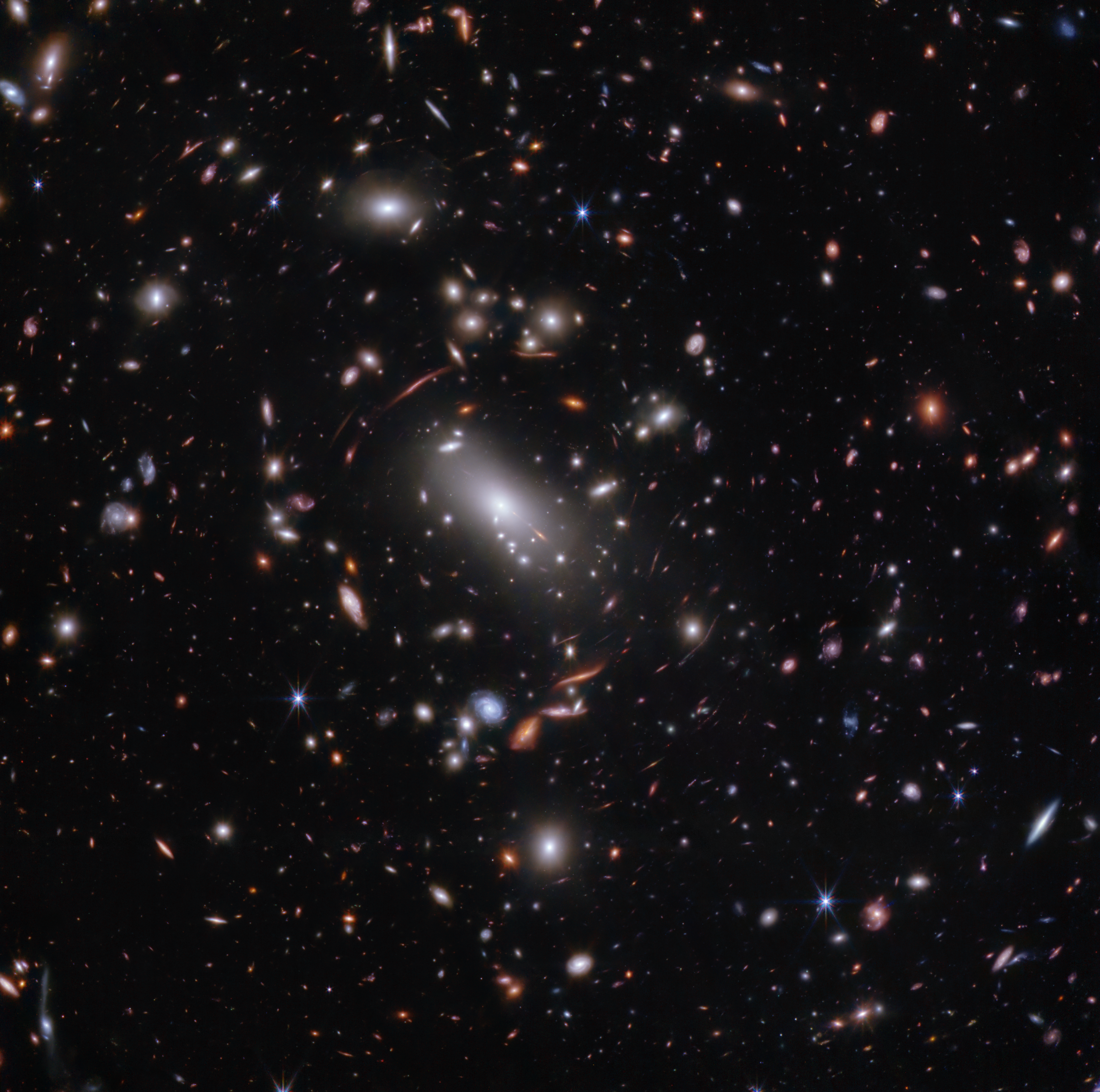
Image credit: NASA, ESA, CSA, STScI, Chris Willott (NRC-Canada), Lamiya Mowla (Wellesley College), Kartheik Iyer (Columbia)
On Christmas Day, 2021, the James Webb Space Telescope (JWST for short) was launched from Guiana Space Centre. It represents a groundbreaking leap forward in our ability to understand the cosmos. Developedin a three-way collaboration between NASA, CSA and ESA, the remarkable work of engineering was designed to aid in addressing some of the most profound astronomical questions, holding exciting prospects on how we would understand far away star systems, galaxies and even potentially aiding in understanding the beginning of the universe.
Initially called the Next Generation Space Telescope as development was started in 1996, itt was conceived as the scientific successor to the Hubble Space Telescope. The Hubble has played a pivotal role in revolutionising our understanding of the universe since its deployment in 1990, most famously discovering the age of the universe, its capabilities are limited primarily to the visible light and ultraviolet portions of the electromagnetic spectrum. The Webb was designed to operate in the infrared range (780nm-1mm in wavelength), enabling it to peer deeper into the universe's history, past the limits of visible light, and opening a new realm of possibilities.
One of the telescope’s primary goals is to study the universe’s first stars and galaxies, formed over 13 billion years ago. As you may have learnt at GCSE, the light from these distant objects has redshifted into the infrared spectrum due to the universe's expansion. This means that the Webb is uniquely equipped to capture and analyse it. This ability can allow astronomers to study the earliest moments after the Big Bang, shedding light on the processes that shaped the cosmos. Another major objective of the telescope is to detect and study exoplanets—planets orbiting stars outside our solar system. These can be detected by monitoring periodic, slight dips in the radiation from a star - a sign of an orbiting planet blocking out some of the light. The JWST is also designed to analyse the chemical composition of exoplanet atmospheres in being able to perform a process akin to spectroscopy, where wavelengths of radiation emitted from planets are able to be analysed to determine which elements and compounds are present within the atmosphere. This means it may play a key role in pioneering further exploration for habitable planets.
The Webb operates from a vantage point 1.5 million kilometers from Earth at the second Lagrange point (L2) from where it orbits the sun. This location minimises interference from Earth’s heat and light, ensuring satisfactory observation conditions. Perhaps the telescope’s most iconic feature, its gold-coated primary mirror, is 6.5 meters (21.3 feet) in diameter—nearly triple the size of Hubble's mirror. Composed of 18 hexagonal segments, the mirror is aligned to function as a single reflector with a gold coating that optimises the mirror's ability to reflect infrared light. If you read one of our previous articles, ‘Electronics in Space’, you might already be aware of the tennis court sized sunshield attached to the telescope. This sunshield keeps the telescope's components at around -233°C, allowing for the necessary infrared observations while also protecting it from the immense amounts of radiation that may be incident upon it. The JWST’s scientific toolkit includes advanced instruments like the Near Infrared Camera (NIRCam), Near Infrared Spectrograph (NIRSpec), and Mid-Infrared Instrument (MIRI). These tools allow it to capture detailed images and spectra, enabling scientists to study everything from stellar nurseries to the atmospheres of distant exoplanets.
The JWST heralds a new era in astronomy, promising discoveries that could reshape our understanding of the cosmos and our place within it. By studying the first galaxies, it may provide critical insights into how the universe evolved over billions of years and its observations of star and planet formation will deepen our knowledge of the processes that gave rise to our own solar system. In the realm of exoplanet research, the Webb could help identify habitable worlds and detect chemical markers thatbiosignatures which suggest the presence of life. Moreover, the JWST serves as a bridge to future space telescopes and missions as its success will inform the development of even more advanced observatories, such as the proposed Habitable Worlds Observatory, which aims to directly image Earth-like exoplanets, and, arguably more excitingly, SPHEREx (Spectro-Photometer for the History of the Universe, Epoch of Reionization, and Ices Explorer) will be launching only a month from when this article is released, collecting data on the near-infrared spectrum of almost 500 million galaxies. As its discoveries unfold in the coming years, the Webb and ensuing projects will not only expand the boundaries of human knowledge but also ignite imaginations, inspiring generations to come to continue the pursuit of exploration and discovery.